
Online Startup Business Ideas for New Entrepreneurs
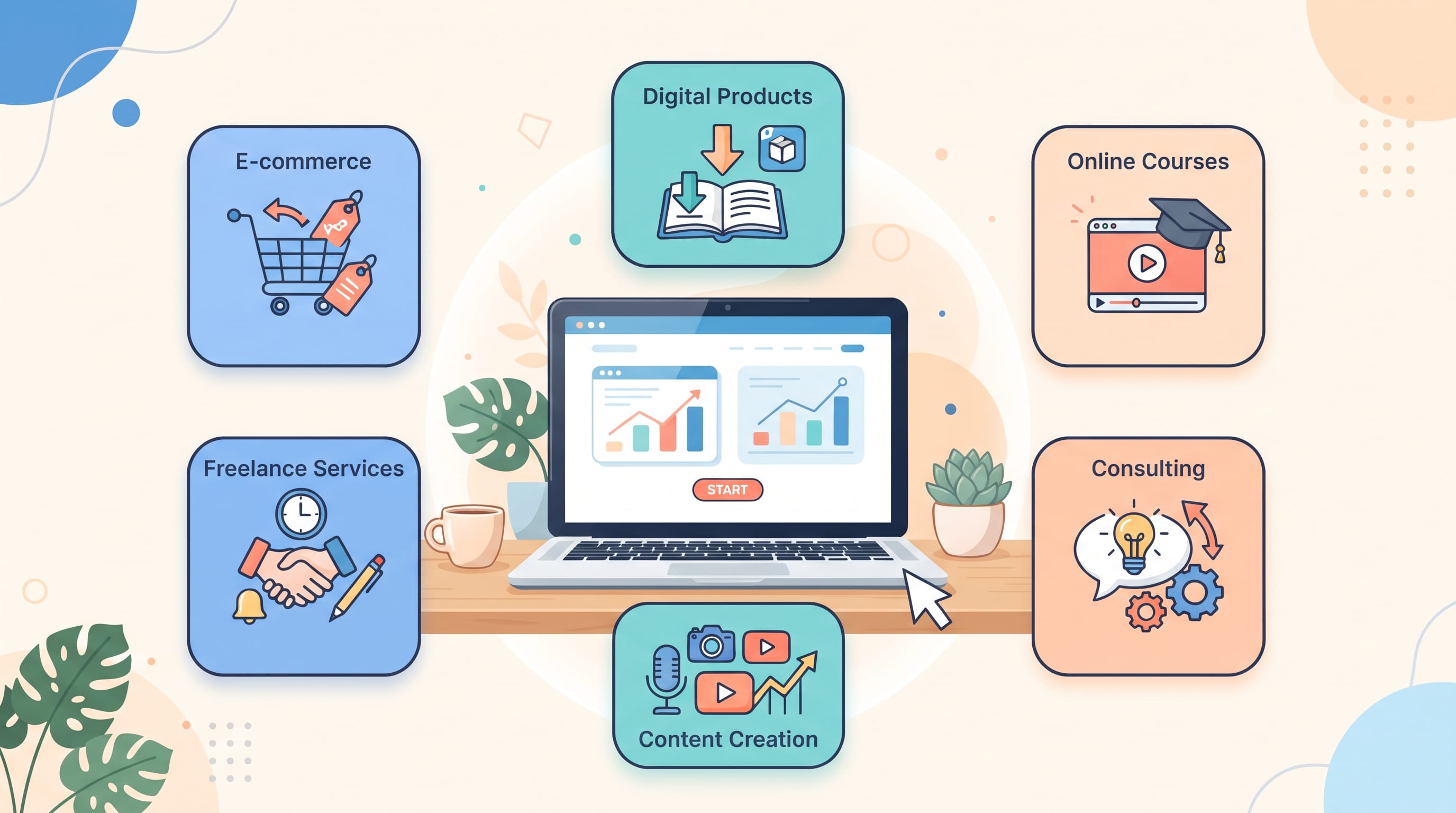
The best online startup business ideas give new entrepreneurs a way to start small, test demand, and grow without immediately taking on the costs of a traditional business. Today, founders can build digital products, launch ecommerce stores, offer specialized services, create subscription businesses, develop niche platforms, or sell knowledge online using tools that are widely available.
However, choosing an idea should not begin with trends alone.
A strong online business usually solves a clear problem for a specific customer.
The opportunity becomes more attractive when customers already spend money trying to solve that problem, the business can reach them online, and the founder can deliver value without excessive upfront investment.
This guide explores practical online startup business ideas for first-time entrepreneurs, along with ways to evaluate and validate each opportunity before investing heavily.
Why Online Startup Business Ideas Appeal to New Founders
Online businesses can often begin with lower fixed costs than traditional physical businesses.
Depending on the model, founders may not need:
- Retail space
- Large inventories
- Expensive equipment
- Large teams
- Multiple business locations
Many digital businesses can begin with a website, software tools, a clear service or product, and a way to reach customers.
Online models can also provide more flexibility.
Customers may come from different cities or countries rather than one local area.
Still, low startup costs do not guarantee easy success.
The strongest online startup business ideas require customer research, consistent marketing, good execution, and enough differentiation to compete.
1. Freelance Service Business
A freelance service business is one of the simplest online businesses to start.
Possible services include:
- Graphic design
- Copywriting
- Video editing
- Web development
- SEO
- Social media management
- Virtual assistance
- Bookkeeping
This model works well because you can start with skills you already have.
You do not need to create a complicated product first.
How to Make It More Scalable
Instead of offering every possible service, choose a specific customer and problem.
For example. Instead of:
Graphic design services
try:
Packaging design for small food brands
Specific positioning can make marketing easier.
As demand grows, freelancers can create standardized packages, hire additional specialists, or build a small agency.
2. Digital Product Startup
Digital products are attractive because the same item can often be sold repeatedly without physical inventory.
Examples include:
- Templates
- Fonts
- Ebooks
- Checklists
- Presets
- Digital planners
- Design assets
- Worksheets
Digital products can be among the most flexible online startup business ideas for creative entrepreneurs.
The challenge is finding a useful product people actually want.
Start by identifying repetitive problems.
For example, if small businesses regularly struggle to create professional social media graphics, a coordinated template collection may offer value.
3. Niche Ecommerce Store
Ecommerce remains a practical model for entrepreneurs who want to sell physical products online.
Instead of creating a general store, focus on a specific category.
Examples might include:
- Home office accessories
- Pet travel products
- Sustainable kitchen goods
- Craft supplies
- Specialty stationery
A focused store can develop stronger branding because every product serves a similar audience.
Start With a Small Catalog
Avoid launching with hundreds of products.
Start with a small group of items and learn:
- What sells
- What customers ask
- Which products receive repeat orders
- What marketing channels work
Then expand based on evidence.
4. Print-on-Demand Business
Print on demand allows entrepreneurs to sell customized products without keeping large inventories.
Common products include:
- T-shirts
- Posters
- Tote bags
- Mugs
- Phone cases
The product is usually produced after an order is placed.
This can reduce inventory risk.
However, the barrier to entry is low, which creates significant competition.
Strong branding and a clear niche are essential.
Instead of creating random designs, build collections around a specific audience or interest.
5. Online Course Business
People regularly pay to learn useful skills.
Potential course topics include:
- Design
- Photography
- Marketing
- Coding
- Business
- Language learning
- Productivity
An online course can be delivered through:
- Recorded videos
- Live sessions
- Worksheets
- Community access
Successful course businesses usually start with expertise and audience needs rather than simply choosing a popular topic.
Ask what outcome students want.
Then design the course around helping them reach that result.
6. Online Coaching or Consulting
Consulting can be one of the strongest online startup business ideas for people with professional experience.
Possible areas include:
- Marketing
- Branding
- Operations
- Ecommerce
- Career development
- Productivity
The startup cost can be relatively low because the main product is expertise.
Begin by defining a narrow problem.
For example. Instead of:
Business consultant
consider:
Ecommerce conversion consultant for small online stores
Specific expertise is easier for potential clients to understand.
7. Micro SaaS Business
Software as a Service can create recurring revenue when customers pay monthly or annually to use a digital tool.
A micro SaaS product focuses on a narrow problem.
Examples might include:
- Reporting dashboards
- Scheduling tools
- Content planning
- Invoice automation
- Simple analytics
- Inventory alerts
Founders do not necessarily need to compete with large software companies.
A small tool can succeed by serving a specific workflow particularly well.
Before building software, validate whether customers care enough about the problem to pay for a solution.
8. AI-Assisted Service Business
AI creates opportunities for new service businesses when technology is combined with real expertise.
Examples include:
- AI-assisted content workflows
- AI product photography
- AI research support
- Marketing automation setup
- AI workflow consulting
The value should not simply be:
“We use AI.”
Clients care more about the outcome.
For example:
“Create ecommerce product visuals faster without arranging a new lifestyle photoshoot for every campaign.”
The technology supports the service rather than becoming the entire value proposition.
Also Read: 25 Digital Product Ideas for Beginners Who Want Extra Income
9. Newsletter Business
A specialized newsletter can become a digital media startup.
Choose a narrow area such as:
- Industry news
- Software tools
- Career opportunities
- Design inspiration
- Market analysis
Revenue can eventually come from:
- Sponsorships
- Paid subscriptions
- Affiliate partnerships
- Products
- Services
The challenge is consistency.
A useful newsletter needs a clear reason for subscribers to open it repeatedly.
10. Niche Content Website
Content websites can attract audiences through search engines, social platforms, email, or direct readership.
Potential niches include:
- Home decor
- Technology
- Pets
- Business
- Tutorials
- Hobbies
Revenue models may include:
- Advertising
- Affiliate marketing
- Sponsorships
- Digital products
- Services
Content websites often take time to build.
They work better when founders treat them as long-term information businesses rather than expecting immediate traffic.
11. Affiliate Marketing Website
Affiliate businesses earn commissions when visitors purchase products or services through referral links.
Useful content may include:
- Reviews
- Comparisons
- Buying guides
- Tutorials
- Resource lists
Choose a niche where customers actively research before buying.
The content should help people make better decisions rather than simply pushing affiliate links.
Trust is essential.
Disclose relevant affiliate relationships and avoid recommending products only because they offer higher commissions.
12. Online Marketplace Startup
A marketplace connects buyers and sellers instead of producing every product itself.
Possible concepts include:
- Digital design marketplace
- Local service platform
- Specialized freelance marketplace
- Handmade product marketplace
- Educational resource marketplace
Marketplace businesses can become scalable, but they face a difficult early-stage problem.
You need both buyers and sellers.
Start with a very narrow niche where you can personally recruit the first participants.
13. Subscription Membership Business
Memberships can create recurring revenue by offering ongoing value.
Possible membership products include:
- Premium content
- Templates
- Tutorials
- Community
- Resources
- Coaching sessions
- Software tools
Customers need a reason to remain subscribed.
Therefore, the value cannot depend only on a large collection of material available on day one.
Create ongoing benefits.
For example, a design membership might provide fresh assets and tutorials each month.
14. Social Media Management Startup
Many small businesses need help maintaining social channels.
Services can include:
- Content planning
- Caption writing
- Graphic creation
- Scheduling
- Reporting
This is another one of the online startup business ideas that can begin as a solo service and develop into an agency.
Choose a niche for stronger positioning.
For example:
Social media management for local beauty businesses
is clearer than offering generic social services to everyone.
15. SEO Content Business
Companies need content that helps potential customers discover them through search.
An SEO content startup could provide:
- Keyword research
- Blog strategy
- Article writing
- Content updates
- Internal linking
The strongest service goes beyond producing large volumes of generic text.
Clients need content that matches search intent, communicates accurately, and supports their business goals.
You can begin as a specialist and later develop a team.
16. Online Design Studio
Designers can build a completely online studio serving clients across different locations.
Potential specialties include:
- Branding
- Logo design
- Packaging
- Web design
- Social media design
- Presentation design
Specialization can improve marketing.
For example:
Branding studio for sustainable consumer products
creates a clearer identity than:
We design everything.
An online studio can later expand into digital products or educational resources, creating several revenue streams.
17. Virtual Assistant Business
Entrepreneurs and small companies often need administrative support without hiring full-time employees.
Virtual assistants may help with:
- Email organization
- Scheduling
- Research
- Data entry
- Customer support
- Ecommerce administration
This can become a scalable business by developing standardized processes and adding additional team members.
The key is reliability and organization.
Also Read: Ecommerce Trends for New Sellers and Creative Product Ideas
18. Online Community Business
Communities can create value by connecting people with similar goals or interests.
Possible audiences include:
- Designers
- Entrepreneurs
- Freelancers
- Students
- Investors
- Hobbyists
Revenue might come from memberships, events, courses, or sponsorships.
However, communities need active participation.
Simply creating a private group does not automatically create value.
Successful communities provide useful discussions, resources, networking, or learning opportunities.
19. B2B Lead Generation Business
Companies are often willing to pay for qualified business leads.
A lead-generation company might specialize in one industry and help clients identify potential customers.
Possible services include:
- Prospect research
- Contact list building
- Outreach systems
- Appointment setting
Quality matters more than quantity.
Sending thousands of irrelevant contacts can damage the client’s reputation.
Good lead generation begins with clear targeting.
20. Online Research Service
Some businesses need help gathering and organizing information.
An online research service might support:
- Competitive analysis
- Market research
- Content research
- Supplier research
- Product comparisons
AI can make certain research tasks faster, but human verification remains important.
Clients pay for useful and reliable conclusions, not simply large amounts of generated information.
This model may work particularly well for researchers with expertise in a specific industry.
How to Choose Between Online Startup Business Ideas
A long list can make decision-making harder.
Use a simple evaluation framework.
Skills
What can you already do well?
Demand
Are customers actively looking for this solution?
Startup Cost
How much money is required before you can test the idea?
Competition
How crowded is the market?
Differentiation
Why would customers choose you?
Revenue Model
How does the business make money?
Scalability
Can revenue grow without costs increasing at exactly the same rate?
The strongest online startup business ideas usually perform reasonably well across several of these areas.
Validate Your Online Startup Idea Before Building
One of the biggest mistakes new founders make is spending months creating something before checking whether customers want it.
Start with basic validation.
Study Existing Customers
Read:
- Reviews
- Community discussions
- Search queries
- Support questions
Look for repeated problems.
Talk to Potential Customers
Ask how they currently solve the problem.
Create a Simple Offer
You may not need a complete platform.
A landing page or manual service can test demand.
Ask for a Real Commitment
Signups are useful, but paying customers are much stronger evidence.
Validation reduces the risk of building something nobody needs.
Start Small and Improve From Real Feedback
New entrepreneurs often imagine that their first version needs every feature.
It does not.
Start with the smallest version that provides genuine value.
- For a SaaS product, this might mean solving one problem.
- For ecommerce, launch a focused collection.
- For services, offer one clear package.
- For digital products, create one strong resource.
Then listen to customers.
Their behavior can guide what you build next.
Common Online Startup Mistakes
Avoid several frequent problems.
Choosing an Idea Only Because It Is Trending
Trends can disappear.
Look for lasting customer problems.
Targeting Everyone
A narrower audience makes messaging easier.
Building Too Much Before Validation
Test the demand first.
Ignoring Marketing
A good product still needs customer acquisition.
Copying Competitors
Understand the market, then create your own positioning.
Depending on One Platform
Try to build assets such as your website and email list that you can control more directly.
Expecting Immediate Profit
Many businesses need time to develop customers, processes, and reputation.
A Simple Startup Workflow for New Entrepreneurs
Turn your favorite online startup business ideas into practical experiments.
Choose a Problem
Identify something customers genuinely want to solve.
Define the Audience
Be specific.
Research Existing Alternatives
Understand what customers already use.
Develop a Simple Offer
Explain the outcome clearly.
Create a Minimum Viable Version
Do not overbuild.
Find the First Customers
Use direct outreach, search, social media, partnerships, or communities where appropriate.
Collect Feedback
Learn why people buy or decline.
Improve the Product
Fix the most important problems.
Build Repeatable Marketing
Identify customer acquisition channels that work.
Scale Carefully
Increase spending and complexity only when the fundamentals are working.
Also Read: 25 Low Cost Business Ideas That Are Easy to Start
Final Thoughts on Online Startup Business Ideas
There are many online startup business ideas available to new entrepreneurs, but the best opportunity is rarely the one that sounds most exciting at first.
A strong startup begins with a useful problem.
Freelance services can be excellent for founders who want to start quickly. Digital products offer low inventory costs. Ecommerce can create strong consumer brands, while micro SaaS products can build recurring revenue around specific business problems.
Online education, consulting, content websites, newsletters, memberships, marketplaces, and specialized agencies provide additional possibilities.
You do not need to launch several models simultaneously.
Choose one.
Define the customer clearly, build a simple offer, and test whether people are willing to pay.
Once you see genuine demand, improve the product, refine the marketing, and create systems that allow the business to grow.
The strongest online startup business ideas are not simply creative concepts. They are ideas that connect a real customer problem with a practical solution, sustainable revenue model, and founder who is willing to learn from the market.
For high-quality fonts to boost your income, check out DM Letter Studio. Our professional fonts are perfect for branding, marketing, and content creation. So, don’t miss this opportunity.