
Top Technology Innovations to Watch in the Coming Years
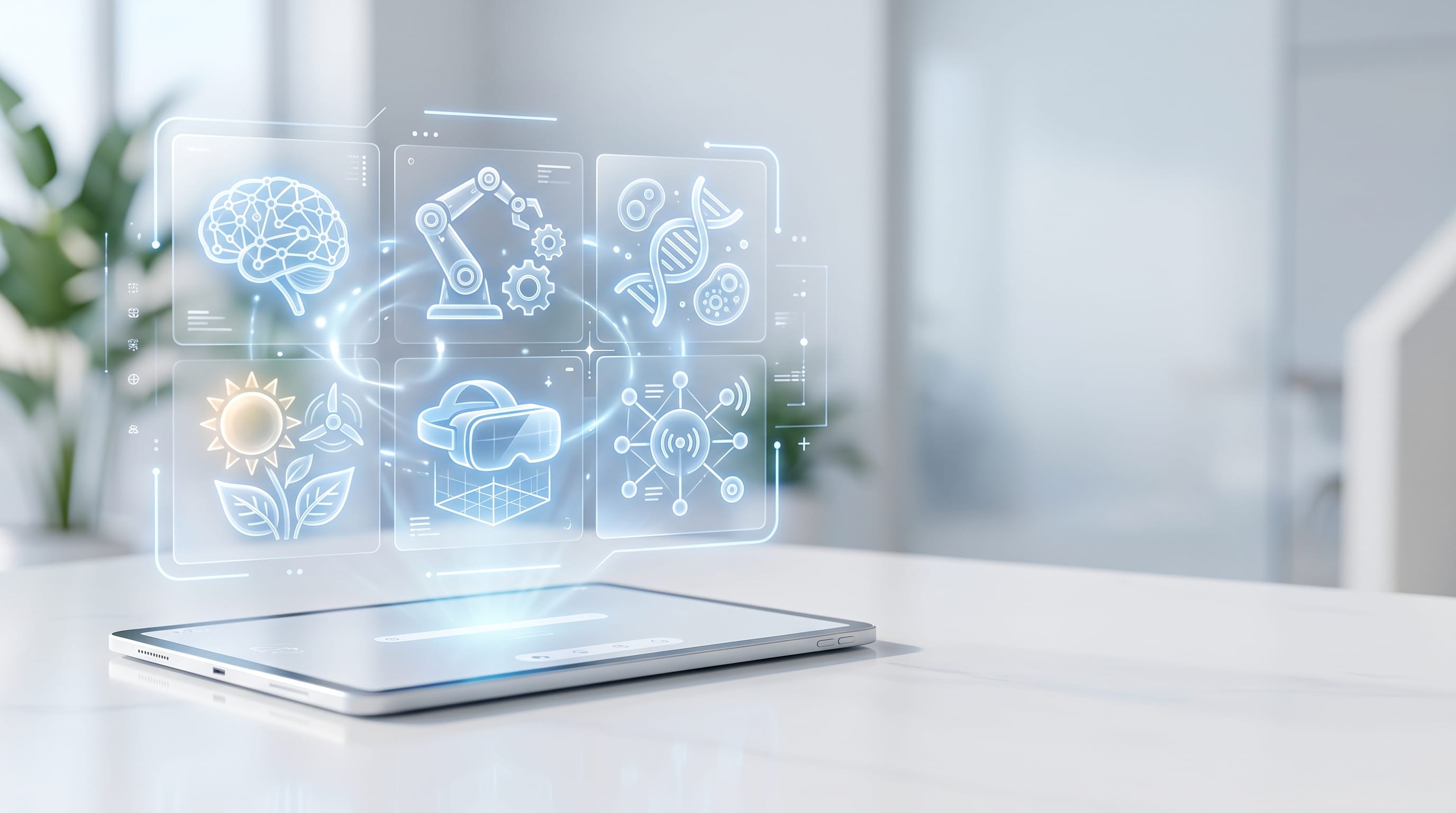
Technology innovations are changing how people work, communicate, travel, create, receive healthcare, and use energy. Artificial intelligence is moving beyond simple chat interfaces, robots are learning to perform more complex physical tasks, scientists are exploring new approaches to medicine and materials, and energy systems are becoming more connected and intelligent.
Many future technologies are no longer purely experimental. The World Economic Forum’s 2026 emerging-technology report highlights advances across energy, materials, health, and computing that are moving from research toward real-world deployment. At the same time, IEEE experts expect artificial intelligence to become increasingly connected to robotics, medicine, energy systems, and professional workflows.
The most important developments will not necessarily arrive as a single revolutionary product. Instead, several technology innovations are beginning to combine. AI can improve robots, advanced chips can accelerate AI, biotechnology can use computational models, and intelligent energy grids can support increasingly digital societies.
Here are some of the most important technology developments worth watching in the coming years.
1. AI Agents Are Becoming More Autonomous
Artificial intelligence has already changed writing, coding, design, research, and customer support.
The next major development is likely to be more autonomous AI agents.
Instead of only responding to a single prompt, an AI agent may be able to:
- Understand a larger goal
- Break it into smaller tasks
- Use different software tools
- Retrieve information
- Complete repetitive actions
- Evaluate results
- Continue working through multiple steps
IEEE’s 2026 technology predictions identify AI agents as an important development for business, particularly for reducing routine work. Industry research also points toward growing interest in multi-agent systems where several specialized AI agents cooperate on complex tasks.
For creators, this could mean AI systems that help manage an entire workflow rather than performing only one isolated task.
A creator might eventually tell an agent:
Prepare this week’s campaign.
The system could help organize content ideas, create drafts, prepare assets, analyze performance data, and recommend improvements.
Human review will still matter, especially for accuracy, originality, strategy, and brand decisions.
2. Physical AI and Humanoid Robots
One of the most visible technology innovations is the convergence of robotics and artificial intelligence.
Traditional industrial robots are usually designed for highly controlled tasks.
Newer systems aim to:
- Understand natural-language instructions
- Recognize unfamiliar objects
- Adapt to changing environments
- Learn from demonstrations
- Perform a wider range of physical tasks
Humanoid robots receive considerable attention because they can potentially operate in environments already designed for people.
Factories, warehouses, healthcare facilities, and homes could eventually use more adaptable robots.
However, the technology still faces major challenges.
Forrester notes that humanoid robots could eventually address labor bottlenecks but expects near-term limitations related to safety, integration, scaling, and data. Meanwhile, robotics companies continue to work toward systems that can understand unfamiliar environments and execute more general instructions.
The future of robotics may therefore arrive gradually rather than through one sudden breakthrough.
3. Robots Are Developing a Sense of Touch
Vision has become increasingly powerful in robotics, but manipulating real objects requires more than cameras.
Humans constantly use touch to judge:
- Pressure
- Texture
- Weight
- Grip
- Movement
Emerging electronic-skin systems are attempting to give robots similar tactile capabilities.
Researchers and robotics companies are developing sensors that can detect pressure and slipping quickly enough to support delicate manipulation.
This could improve robots used in:
- Healthcare
- Manufacturing
- Agriculture
- Warehousing
- Home assistance
Recent work on electronic skin demonstrates how tactile sensors could allow robots to adjust their grip almost immediately, making physical interaction more precise.
This is a good example of how future technology innovations may depend on combining software intelligence with better physical sensing.
4. Quantum Computing Is Moving Toward Practical Experiments
Quantum computing has been discussed for years, but commercial experimentation is becoming more serious.
Unlike conventional computers, quantum systems use quantum bits and specialized algorithms to approach particular computational problems.
Potential long-term applications include:
- Molecular simulation
- Materials discovery
- Financial modeling
- Complex optimization
- Cryptography
- Drug research
Businesses are already investing in quantum expertise and early experiments, although broad commercial usefulness remains uncertain. Forrester still categorizes quantum computing as a longer-term technology, while enterprise interest is increasing as organizations prepare for possible applications in areas such as finance, pharmaceuticals, and manufacturing.
This makes quantum computing one of the most interesting technology innovations to monitor, but it is important to avoid assuming that quantum computers will replace conventional computers.
They are more likely to complement existing systems for specialized tasks.
5. Post-Quantum Cybersecurity
Quantum computing also creates a security challenge.
Powerful future quantum computers could threaten some forms of encryption currently protecting:
- Financial systems
- Government networks
- Corporate information
- Personal data
This is why researchers are developing post-quantum cryptography.
These security methods are designed to remain resistant to attacks from future quantum computers.
Post-quantum cryptography is becoming important enough to appear among updated critical and emerging technology priorities in the United States.
Organizations do not need to wait for large-scale quantum computers before preparing.
Cybersecurity systems often remain in service for many years, so migration can begin well before the threat becomes immediate.
6. Predictive and Autonomous Energy Grids
Electricity systems are becoming more complex.
Renewable energy sources such as solar and wind can vary throughout the day.
Meanwhile, electric vehicles, home batteries, data centers, and distributed energy resources are creating new opportunities for storing and managing electricity.
One major development is the concept of everything-to-grid energy.
Instead of viewing cars, buildings, and batteries only as electricity consumers, these systems can potentially provide stored electricity back to the grid when demand rises.
The World Economic Forum identifies everything-to-grid energy as one of the leading emerging technologies of 2026, pointing to the growing potential of distributed batteries and vehicles to become active grid resources.
AI could make these networks even smarter by predicting:
- Demand
- Weather
- Electricity supply
- Battery availability
- Equipment problems
IEEE also highlights predictive, increasingly autonomous power grids as an important direction.
7. Better Battery and Energy Storage Systems
Energy storage will remain central to many future technology innovations.
Better batteries could improve:
- Electric vehicles
- Renewable-energy storage
- Mobile electronics
- Robotics
- Industrial equipment
Innovation is taking place across:
- Chemistry
- Manufacturing
- Recycling
- Charging speed
- Energy density
- Safety
The goal is not simply to create batteries that hold more power.
Future systems also need to become:
- Less expensive
- Longer lasting
- Safer
- Easier to recycle
Battery innovation can therefore influence several industries at once.
8. Direct Lithium Extraction
Growing battery demand also increases the need for key materials.
Lithium is essential for many current battery technologies.
Traditional extraction can require large amounts of land and water.
Direct lithium extraction is designed to recover lithium from brines more efficiently.
The World Economic Forum’s 2026 report identifies direct lithium extraction as an emerging technology moving toward larger-scale use, with the potential to reduce some of the time and resource demands associated with conventional evaporation processes.
If the technology scales successfully, it could become an important part of the broader transition toward electrification.
Also Read: Technology for Entrepreneurs: A Practical Guide for New Founders
9. AI-Powered Drug Discovery
Developing a new medicine can take years.
Researchers must examine enormous numbers of potential molecules and understand how they interact with biological systems.
AI can help narrow the search.
Models can assist researchers in:
- Predicting molecular behavior
- Identifying promising drug targets
- Comparing potential compounds
- Analyzing biological data
The World Economic Forum notes that scientific discovery is increasingly moving from physical experimentation toward computational modeling, with AI helping researchers investigate molecules and biological pathways before committing to expensive laboratory work.
This does not eliminate laboratory testing.
Instead, it may help scientists determine which experiments are most promising.
10. Personalized and Adaptive Medicine
Healthcare is gradually moving toward greater personalization.
Traditional treatments may use similar approaches across large patient groups.
Future medical systems could adjust treatment based on:
- Genetics
- Biomarkers
- Wearable data
- Lifestyle
- Treatment response
IEEE highlights adaptive bio-AI interfaces as a future direction where systems continuously interpret biological signals and potentially help treatments adjust in real time.
Potential applications could include:
- Diabetes management
- Rehabilitation
- Drug dosing
- Neurological treatment
- Personalized wellness
These technology innovations could make healthcare more responsive to individual patients rather than relying only on population averages.
11. Wearable Health Technology
Wearable devices are evolving beyond basic step counting.
Future wearables may track more sophisticated signals related to:
- Heart activity
- Sleep
- Movement
- Temperature
- Recovery
- Metabolic health
The long-term opportunity lies in continuous monitoring.
Instead of measuring health only during occasional appointments, connected systems could identify important changes earlier.
However, health wearables must address:
- Accuracy
- Privacy
- Security
- Medical validation
More data does not automatically create better healthcare.
The value depends on how reliably the information can be interpreted.
12. Spatial Computing
Computers are gradually moving beyond traditional flat screens.
Spatial computing combines digital information with physical environments.
This can include:
- Mixed reality
- 3D interfaces
- Spatial mapping
- Hand tracking
- Wearable displays
Possible applications include:
- Product design
- Training
- Education
- Architecture
- Entertainment
- Remote collaboration
For designers and creators, spatial interfaces may create entirely new forms of content.
Instead of designing only pages or screens, creators may increasingly design experiences that exist around the user.
13. AI-Generated 3D Worlds
Generative AI began with text and images, but 3D generation is also advancing.
Future tools may allow creators to describe an environment and automatically generate:
- Objects
- Textures
- Characters
- Lighting
- Scenes
This could accelerate workflows in:
- Gaming
- Animation
- Architecture
- Ecommerce
- Virtual production
A designer might eventually generate a complete interactive product environment from a short description and then refine it manually.
This could make professional 3D creation accessible to far more people.
14. Next-Generation Semiconductors
Nearly every modern digital system depends on semiconductor innovation.
AI models, autonomous vehicles, smartphones, robots, and data centers require increasingly specialized computing hardware.
Future developments include:
- AI accelerators
- More efficient processors
- Integrated photonics
- Advanced packaging
- New semiconductor materials
Integrated photonics and advanced materials have recently gained greater attention within critical technology strategies because conventional electronic scaling alone may not meet future computing requirements.
Better chips can create a multiplier effect.
When computing becomes faster and more efficient, many other technology innovations improve with it.
15. Edge AI
Not every AI task needs to run in a distant data center.
Edge AI processes information directly on devices such as:
- Smartphones
- Cameras
- Cars
- Robots
- Industrial machines
Advantages can include:
- Faster response
- Reduced network dependence
- Better privacy
- Lower bandwidth requirements
Imagine a robot that needs to adjust its grip immediately.
Sending every sensor signal to a remote server may introduce unnecessary delay.
Processing data locally can enable much faster decisions.
Edge AI will become especially important as intelligent systems become embedded throughout physical environments.
16. Autonomous Transportation
Self-driving technology continues to evolve across:
- Cars
- Trucks
- Delivery robots
- Drones
- Industrial vehicles
The future may not immediately produce fully autonomous transportation everywhere.
Instead, autonomy may expand gradually in controlled environments.
For example:
- Warehouses
- Ports
- Mines
- Delivery routes
- Specific city zones
These situations reduce some of the complexity found in unrestricted public roads.
Over time, better sensors, AI models, mapping, and computing could expand the range of autonomous applications.
Also Read: Smart Home Technology Ideas for a More Comfortable Lifestyle
17. Drone Delivery and Autonomous Logistics
Delivery drones represent another rapidly developing area of physical automation.
Potential uses include:
- Medical deliveries
- Food
- Ecommerce
- Emergency supplies
Autonomous logistics can be particularly valuable when:
- Roads are difficult
- Delivery speed matters
- Distances are short
- Traditional transport is expensive
Robotics investment in 2026 continues to include companies working on drone delivery, autonomous manufacturing, logistics, and inspection systems.
The biggest obstacles are often not purely technical.
Regulation, airspace management, safety, cost, and public acceptance also determine how quickly these systems can expand.
18. Advanced Materials
Some of the most important technology innovations may be almost invisible to consumers.
Advanced materials can improve:
- Electronics
- Batteries
- Aerospace
- Construction
- Medicine
- Manufacturing
New materials may become:
- Lighter
- Stronger
- More conductive
- More heat resistant
- More recyclable
Emerging areas such as two-dimensional materials and high-entropy alloys are receiving increasing attention because they can enable new properties that conventional materials cannot easily provide.
Small improvements in materials can create major improvements in finished products.
19. Biotechnology and Engineered Biology
Biotechnology increasingly combines biology, AI, and automation.
Scientists are learning how to design biological processes that can potentially produce:
- Medicines
- Food ingredients
- New materials
- Industrial chemicals
Instead of manufacturing everything through traditional chemical processes, some future products may be produced using engineered microorganisms.
This could reduce resource consumption in certain industries while enabling entirely new types of products.
The World Economic Forum’s 2026 emerging-technology work highlights how scientific discovery is becoming increasingly personalized, decentralized, and computationally assisted.
20. AI-Native Software Development
Software development itself is changing.
AI tools can already help developers:
- Generate code
- Find bugs
- Write documentation
- Create tests
- Explain unfamiliar systems
The next stage may involve more autonomous software agents that can work across larger development tasks.
Forrester identifies agentic software development as an emerging area that could accelerate software workflows as agent coordination and safeguards improve.
This could change the role of software developers.
Instead of writing every line manually, more time may be spent defining systems, supervising agents, reviewing outputs, and solving higher-level problems.
How Technology Innovations Will Work Together
The most important future developments are unlikely to remain separate.
Consider an autonomous warehouse.
It could combine:
- AI agents
- Robotics
- Edge computing
- Advanced sensors
- Efficient chips
- Predictive energy systems
A personalized healthcare platform might combine:
- Wearables
- AI
- Biotechnology
- Cloud computing
- Advanced sensors
This convergence is one reason technological change can accelerate.
One breakthrough creates new possibilities for another.
Technology Innovations and the Future of Work
Many people worry that new technology will replace jobs.
Some tasks will certainly become automated.
However, technology also creates:
- New occupations
- New industries
- New creative tools
- New business models
The transition will require adaptation.
Useful skills may increasingly include:
- AI literacy
- Critical thinking
- Creative direction
- Data interpretation
- Technical communication
- Digital security
The ability to work with intelligent systems may become as important as knowing how to use computers today.
Challenges Behind Future Technology Innovations
Not every promising invention succeeds.
Future technologies must overcome challenges involving:
- Cost
- Regulation
- Infrastructure
- Safety
- Privacy
- Security
- Energy use
- Public acceptance
Humanoid robots, for example, may look impressive in demonstrations but still face major reliability and integration challenges in everyday workplaces. Quantum computing has enormous theoretical potential, but broad commercial value remains uncertain.
Therefore, it is useful to distinguish between:
Interesting technology
and
Technology ready for widespread adoption.
The two are not always the same.
Technology Innovations to Watch Closely
For readers who want to follow the next wave of change, these areas deserve particular attention:
- AI agents
- Physical AI
- Humanoid robots
- Quantum computing
- Post-quantum security
- Intelligent power grids
- Advanced batteries
- Biotechnology
- Personalized medicine
- Edge AI
- Spatial computing
- Autonomous transportation
- Advanced semiconductors
- New materials
Some may scale within a few years.
Others could require a decade or longer.
The important point is to watch how quickly research becomes practical infrastructure.
Also Read: AI Technology for Business That Saves Time and Money
Final Thoughts on Technology Innovations
The most exciting technology innovations are moving beyond isolated digital tools and beginning to influence the physical world.
AI agents are becoming capable of handling more complex workflows. Robots are gaining better intelligence and sensing. Quantum computing is attracting serious enterprise experimentation. Energy grids are becoming more distributed and predictive. Healthcare is moving toward personalized, data-driven treatment, while advanced chips and materials support progress across almost every other field.
At the same time, the future remains uncertain.
Some technologies will advance quickly.
Others will encounter technical, financial, regulatory, or social barriers.
That is why the best approach is not to assume every futuristic concept will immediately become mainstream.
Instead, watch for evidence of real deployment.
The most important technology innovations will be the ones that move successfully from impressive demonstrations into reliable systems that improve everyday life.
Over the coming years, the biggest transformation may come not from one invention but from the combination of artificial intelligence, robotics, biotechnology, energy systems, advanced computing, and new materials.
Together, these developments are creating a technological landscape where computers are becoming more intelligent, machines are becoming more capable, healthcare is becoming more personalized, and physical infrastructure is becoming increasingly connected.
That makes the next several years an especially important period for anyone interested in the future of technology.

For high-quality fonts to boost your income, check out DM Letter Studio. Our professional fonts are perfect for branding, marketing, and content creation. So, don’t miss this opportunity.