
AI Marketing Examples and Ideas for Better Digital Strategy
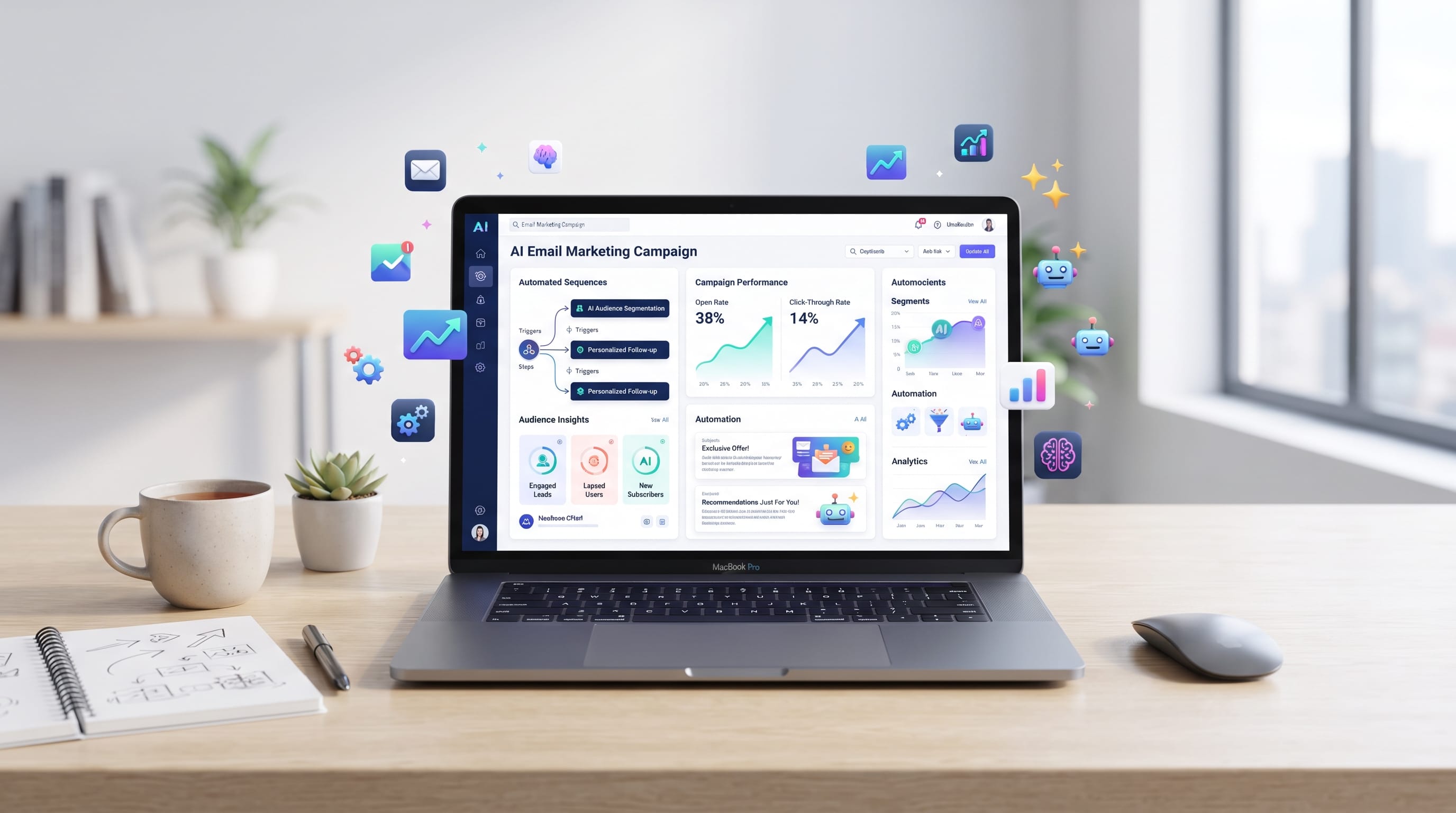
Practical AI marketing examples can help marketers understand where artificial intelligence actually fits into a digital strategy. AI is no longer limited to generating a few paragraphs of content. Marketing teams can use it to organize research, personalize messages, analyze customer behavior, create campaign variations, improve advertising workflows, assist with SEO, and automate repetitive tasks.
However, using AI successfully requires more than adding another software tool.
The strongest applications start with a clear marketing problem.
For example, a company may need to create personalized email campaigns for different customer groups. Another team might struggle to analyze hundreds of customer reviews. An ecommerce business may need more product descriptions, while a content team may want faster ways to repurpose existing articles.
The following AI marketing examples show how marketers can connect AI with practical goals while keeping human strategy, review, and creativity at the center of the process.
What Are AI Marketing Examples?
AI marketing examples are practical uses of artificial intelligence across marketing activities.
These applications may involve:
- Content creation
- Customer segmentation
- Personalization
- Email marketing
- Advertising
- SEO
- Social media
- Ecommerce
- Customer support
- Analytics
- Workflow automation
AI can help marketers process information faster or generate initial drafts, but it does not remove the need for marketing judgment.
A useful AI workflow still needs someone to determine:
- Who the audience is
- What the campaign should achieve
- Which message is appropriate
- Whether the output is accurate
- How success will be measured
Think of AI as part of the marketing system rather than the entire strategy.
1. AI Marketing Examples for Content Ideas
Content teams often spend significant time deciding what to publish.
AI can help brainstorm ideas based on:
- Customer questions
- Product features
- Audience problems
- Keyword groups
- Seasonal campaigns
- Funnel stages
For example, a home decor company could provide a list of common customer questions and ask AI to organize them into blog categories.
The output might suggest content around:
- Small-space decorating
- Furniture selection
- Seasonal decor
- Room organization
The marketer still decides which ideas deserve publication.
This is one of the simplest AI marketing examples because it improves planning without handing over the entire creative process.
2. AI Marketing Examples for Blog Content
AI can assist with early stages of blog production.
Possible tasks include:
- Creating outlines
- Suggesting headings
- Organizing research notes
- Drafting introductions
- Producing FAQ ideas
- Identifying missing sections
For example, a marketing team writing about email automation could provide its research notes and ask AI to organize them into a logical article structure.
The writer then develops the article with original examples, verified information, brand voice, and editorial judgment.
Use AI as a Drafting Assistant
Avoid publishing raw generated text.
Review for:
- Accuracy
- Repetition
- Generic statements
- Tone
- Brand consistency
- Search intent
The goal is faster preparation, not lower editorial standards.
3. AI Marketing Examples for Content Repurposing
One strong article can become several marketing assets.
Suppose a company publishes a detailed guide about improving website conversions.
AI could help transform the main ideas into:
- Email newsletter
- Social posts
- Video outline
- Short checklist
- LinkedIn post
- FAQ section
This reduces the need to start from zero every time.
Content repurposing is especially useful for small marketing teams because it allows one researched idea to support several distribution channels.
4. AI Marketing Examples for Email Marketing
Email campaigns often need several versions of the same core message.
AI can help marketers draft:
- Subject lines
- Preview text
- Product announcements
- Follow-up messages
- Welcome emails
- Re-engagement campaigns
Imagine an ecommerce company launching a new collection.
Instead of writing one message for everyone, the team could develop different drafts for:
- New subscribers
- Previous customers
- High-value customers
- Customers interested in a specific category
These AI marketing examples demonstrate how AI can support segmentation while marketers remain responsible for the final offer and messaging.
5. AI Marketing Ideas for Personalization
Personalization becomes more useful when it reflects meaningful customer behavior.
Businesses might personalize:
- Product recommendations
- Email content
- Landing pages
- Offers
- Educational resources
For example, a software company could provide different onboarding content depending on whether a customer works in marketing, design, or sales.
An ecommerce business might recommend products related to previous browsing or purchase behavior.
AI can help analyze patterns, but personalization should still respect privacy and avoid making customers feel excessively monitored.
6. AI Marketing Examples for Customer Segmentation
Traditional segmentation might categorize customers based on:
- Location
- Age
- Purchase history
- Subscription type
AI-assisted analysis can help identify additional patterns in larger datasets.
For example, a business might discover groups such as:
- Frequent repeat buyers
- Seasonal customers
- Customers likely to purchase after discounts
- Customers who engage heavily with educational content
These groups can receive different campaigns.
Better segmentation can improve relevance because not every customer needs the same message.
7. AI Marketing Examples for Advertising
Digital advertising requires constant testing.
Marketers often need variations of:
- Headlines
- Descriptions
- Visual concepts
- Calls to action
- Audience messages
AI can make the brainstorming stage faster.
For example, a marketer may start with one core product benefit and generate twenty different headline directions.
The team can then select the strongest versions and test them.
Create Variations, Not Random Campaigns
Keep one strategic idea consistent.
If the main benefit is:
Save time managing invoices
AI could help explore variations around convenience, speed, or administrative simplicity.
This is more useful than asking the system to create unrelated advertising ideas.
Also Read: AI in Education for Better Learning and Teaching Today
8. AI Marketing Examples for Social Media
Social media requires frequent content production.
AI can assist with:
- Caption drafts
- Post variations
- Content calendars
- Hook ideas
- Video scripts
- Carousel outlines
Suppose a design company publishes a new branding project.
AI could help create:
- Instagram: visual storytelling caption
- LinkedIn: business-focused case-study post
- Pinterest: keyword-focused description
The central story remains the same while the format changes for each platform.
Human editing is still important because different communities have different expectations.
9. AI Marketing Ideas for SEO
AI can support several parts of SEO research and planning.
Marketers might use it to:
- Group keywords
- Suggest topic clusters
- Organize search intent
- Create outline ideas
- Improve internal-link planning
- Generate metadata drafts
For example, a site with hundreds of keyword ideas could use AI to organize them into themes such as:
- Beginner guides
- Product comparisons
- Tutorials
- Inspiration
- Troubleshooting
This can make editorial planning easier.
However, keyword volume, ranking difficulty, and other search metrics should come from reliable data sources rather than generated estimates.
10. AI Marketing Examples for Keyword Clustering
Large keyword lists can become difficult to manage manually.
AI can help group semantically related terms.
For example.
Main Topic: Logo Design
Related cluster:
- logo design ideas
- logo color combinations
- logo typography
- minimal logo design
- logo redesign examples
Another cluster might focus on:
Packaging Design
with topics such as:
- packaging inspiration
- packaging typography
- sustainable packaging
- packaging design mistakes
The marketer can then determine whether each cluster needs one comprehensive article or several separate pages.
11. AI Marketing Examples for Ecommerce
Ecommerce companies can use AI across several parts of marketing.
Possible applications include:
- Product description drafts
- Product recommendations
- Image concepts
- Email campaigns
- Customer segmentation
- Review analysis
For example, a store with hundreds of products might use AI to produce first drafts of product descriptions based on verified specifications.
The final descriptions should still be reviewed carefully.
AI should never invent:
- Materials
- Dimensions
- Features
- Certifications
- Product benefits
Accurate information is essential.
12. AI Marketing Ideas for Product Recommendations
Recommendation systems can help shoppers discover relevant products.
For example:
A customer viewing a desk might also see:
- Desk chair
- Lamp
- Organizer
- Storage cabinet
A fashion customer viewing a jacket could receive complementary product suggestions.
Good recommendations make shopping easier.
Poor recommendations simply create noise.
The purpose should be relevance rather than showing the maximum possible number of products.
13. AI Marketing Examples for Customer Reviews
Customer reviews can contain valuable marketing information.
However, reading thousands of them manually can be difficult.
AI can help categorize common themes such as:
- Product quality
- Delivery
- Customer service
- Packaging
- Price
- Ease of use
For example, a company might discover that customers frequently praise its packaging but complain about unclear instructions.
Marketing can emphasize the packaging strength while product teams improve instructions.
This is one of the AI marketing examples where AI can turn unstructured feedback into more manageable insights.
14. AI Marketing Examples for Customer Support
Customer support conversations can influence marketing because they reveal real customer questions.
AI-assisted systems may help with:
- FAQ responses
- Order-status questions
- Basic product information
- Routing support requests
They can also help marketing teams identify recurring questions that deserve new content.
For example, if customers repeatedly ask how a product works, the company might create:
- Tutorial
- Product video
- FAQ article
- Onboarding email
Customer support data can therefore become a useful source of content ideas.
15. AI Marketing Ideas for Lead Generation
B2B marketers can use AI to improve lead-generation workflows.
Possible applications include:
- Lead qualification
- Email personalization
- Research summaries
- Follow-up drafts
- Content recommendations
For example, a sales team might use AI to summarize information about a prospective company’s industry before preparing outreach.
The final message can then focus on a relevant business problem rather than sending generic promotional copy.
Personalization works better when it demonstrates actual relevance.
Also Read: AI in Healthcare for Better Systems and Patient Outcomes
16. AI Marketing Examples for Landing Pages
Landing pages require clear communication.
AI can help marketers brainstorm:
- Headlines
- Subheadings
- Benefit statements
- CTA alternatives
- FAQ questions
Suppose a product helps small teams manage projects.
Possible headline angles might focus on:
- Saving time
- Reducing confusion
- Better collaboration
- Fewer missed deadlines
AI can quickly generate several directions.
The marketing team should then choose one based on audience research and campaign intent.
17. AI Marketing Examples for Campaign Research
Before launching a campaign, marketers usually need to understand:
- Audience
- Market
- Competitors
- Customer problems
- Messaging opportunities
AI can help organize research that the team has already collected.
For example, marketers can provide:
- Survey responses
- Interview notes
- Customer reviews
- Sales feedback
and ask the system to identify repeated themes.
This can make large amounts of qualitative information easier to analyze.
Important conclusions should still be checked against the original material.
18. AI Marketing Ideas for Marketing Analytics
Marketing teams generate large amounts of performance data.
AI-assisted analysis can help summarize:
- Campaign results
- Traffic patterns
- Conversion changes
- Email performance
- Audience trends
For example, instead of reviewing several reports separately, a marketer could create a summary that highlights:
- What improved
- What declined
- Possible explanations
- What needs further investigation
These AI marketing examples can reduce reporting time, but marketers should distinguish between correlation and actual causes.
Data still needs interpretation.
19. AI Marketing Examples for Workflow Automation
Some marketing work is highly repetitive.
Possible automation opportunities include:
- Organizing content briefs
- Creating task summaries
- Formatting campaign data
- Tagging content
- Preparing first drafts
- Generating report summaries
The goal is to automate predictable steps.
Strategic decisions should remain with the people responsible for the campaign.
A good question is:
Does this task require judgment, or does it mostly require repetition?
Repetitive tasks are usually stronger candidates for automation.
20. AI Marketing Ideas for Small Businesses
Small companies may benefit significantly from selective AI use because their teams have limited time.
For example, one business owner might use AI to support:
- Monthly content planning
- Email drafts
- Social captions
- Customer FAQ organization
- Blog outlines
- Review analysis
The business does not need an AI solution for every process.
Start with the area that consumes the most time.
Then determine whether the new workflow creates measurable value.
How to Turn AI Marketing Examples Into a Strategy
Seeing examples is useful, but marketers still need a structured implementation process.
Identify the Problem
Start with a specific challenge.
For example:
Our team spends too long repurposing blog content.
Choose One AI Use Case
Use AI to create first drafts for several distribution formats.
Establish Human Review
A marketer checks accuracy, voice, and relevance.
Measure the Benefit
Track:
- Time saved
- Engagement
- Output quality
- Conversion impact
Improve the Workflow
Refine prompts and review standards.
Expand Carefully
Introduce AI into additional processes only when there is a clear reason.
This approach prevents AI from becoming another complicated collection of tools.
Common AI Marketing Mistakes
Marketers should avoid several common problems.
Publishing AI Content Without Review
Always check accuracy and quality.
Using AI Without a Marketing Goal
Technology needs a purpose.
Creating Too Much Generic Content
More content does not automatically create better results.
Ignoring Customer Privacy
Use customer data responsibly.
Trusting Generated Statistics
Verify factual claims through appropriate sources.
Automating Sensitive Communication
Some interactions deserve direct human attention.
Losing Brand Voice
AI drafts should be edited to sound like the actual brand.
Measuring Activity Instead of Results
Generating more posts is not success unless those posts support meaningful objectives.
Keep Human Judgment at the Center
The strongest AI marketing examples still involve human decision-making.
Marketers understand:
- Brand positioning
- Customer emotions
- Business priorities
- Cultural context
- Creative quality
AI can accelerate information processing and production, but it does not automatically understand which idea best supports a long-term brand.
Use AI to increase options.
Then use human judgment to select and refine them.
Also Read: 25 Best AI Tools to Boost Productivity in 2026
Final Thoughts on AI Marketing Examples
The most useful AI marketing examples show that artificial intelligence can support many parts of digital marketing without needing to replace the people responsible for strategy.
Content teams can use AI for ideation, outlines, and repurposing. Email marketers can develop message variations. SEO teams can organize keyword clusters. Ecommerce companies can analyze reviews and prepare product-content drafts, while advertising teams can explore more creative variations.
AI can also support personalization, customer service, analytics, research, and repetitive workflow automation.
The important question is not:
Where can we use AI?
A better question is:
Which marketing problem could AI help us solve more effectively?
Start with one clear use case, build a repeatable process, add human review, and measure whether it actually improves efficiency or marketing results.
When used this way, AI marketing examples become more than interesting experiments. They provide practical ideas for building a digital strategy where technology supports better research, faster execution, stronger personalization, and more informed marketing decisions.

For high-quality fonts to boost your income, check out DM Letter Studio. Our professional fonts are perfect for branding, marketing, and content creation. So, don’t miss this opportunity.