
Future AI Technology Trends That Will Shape the Next Decade
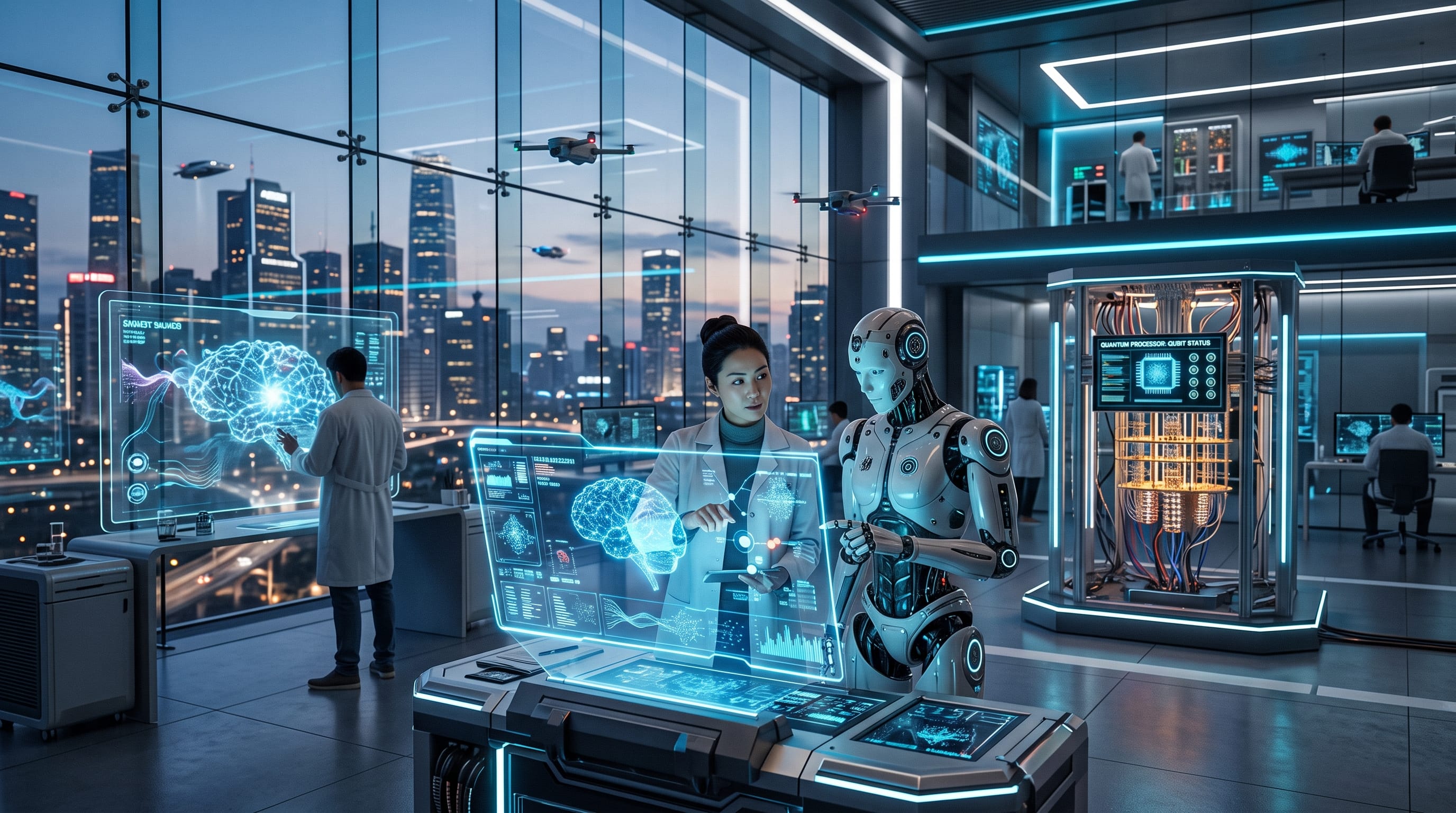
Future AI technology trends will change how people work, create, communicate, learn, and interact with machines over the next decade. Artificial intelligence is moving beyond simple chatbots and content generators toward systems that can reason across different media, use digital tools, complete longer workflows, and interact with the physical world.
Recent progress suggests that AI development will not follow a single path. Some systems will become larger and more capable, while others will become smaller, faster, and specialized for particular devices or industries. AI will appear in software agents, robots, healthcare platforms, classrooms, creative applications, scientific laboratories, and everyday consumer products.
Stanford’s 2026 AI Index reports continued progress across language, speech, image generation, video, reasoning, robotics, and agent-based systems. However, it also identifies a widening gap between what AI can do and society’s ability to evaluate, govern, and understand it responsibly.
Understanding the major future AI technology trends can help professionals, students, businesses, and technology readers prepare for both the opportunities and the risks ahead.
1. Future AI Technology Trends Will Be Led by AI Agents
One of the most significant developments will be the growth of AI agents. Unlike basic chatbots that produce a single response, agents are designed to pursue goals, use tools, and complete connected tasks on behalf of a user.
An AI agent might research several products, compare prices, organize the findings, prepare a report, and create a follow-up task. In a business setting, an agent could review support requests, locate relevant information, draft replies, and send difficult cases to a human employee.
Current agent-building systems already combine models with tools such as web search, file retrieval, computer interaction, and workflow controls. OpenAI introduced developer tools for building agent-based applications in 2025 and has continued expanding the systems used to design, deploy, evaluate, and manage agents.
AI Agents Will Complete Longer Workflows
Future agents may handle tasks that currently require several applications and repeated human input. Their responsibilities could include:
- Organizing research
- Updating project records
- Preparing reports
- Analyzing documents
- Managing routine customer requests
- Coordinating schedules
- Monitoring business data
- Supporting software development
These systems will still require clear boundaries. An agent should not be allowed to send payments, delete files, publish information, or make high-impact decisions without suitable authorization.
As a result, one of the most important future AI technology trends will be the development of permission systems, human approval steps, activity logs, and stronger methods for evaluating agent reliability.
2. Multimodal AI Will Become the Standard
Most early generative AI tools focused mainly on text. Future systems will increasingly understand and generate combinations of text, images, audio, video, code, and information from sensors.
This is known as multimodal AI. It allows one system to work with different kinds of information instead of requiring a separate application for every format.
For example, a multimodal assistant could:
- Read a written instruction
- Examine a photograph
- Listen to a spoken question
- Analyze a chart
- Watch a short video
- Respond through text or voice
The 2026 AI Index tracks improvements across these areas, showing that multimodal capability is becoming central to modern model development.
Future AI Assistants Will Better Understand Context
Multimodal systems could make AI assistants more practical in everyday situations. A technician might point a camera at a machine, describe the problem by voice, and receive troubleshooting guidance based on both the image and the spoken explanation.
A student could upload a handwritten equation and ask for a visual explanation. A designer could share a rough layout while discussing changes through voice commands. A traveler might use a camera to translate a sign and receive useful information about the surrounding location.
These experiences will make AI feel less like a text box and more like an interactive digital assistant.
3. Future AI Technology Trends Will Bring More Personalization
AI tools will become increasingly personalized. Instead of providing the same experience to everyone, future assistants may adapt to a user’s knowledge level, communication style, profession, responsibilities, and recurring preferences.
A personalized system could remember:
- Preferred writing formats
- Common tasks
- Accessibility requirements
- Learning goals
- Work schedules
- Frequently used tools
- Important project instructions
In education, AI could adjust explanations based on how quickly a student learns. In business, an assistant could prepare reports using a company’s preferred structure. In creative work, a tool might understand a designer’s usual dimensions, file formats, and project requirements.
However, personalization will depend heavily on trust. Users should know what information is stored, why it is stored, and how to remove it. Privacy controls will therefore become a central part of future AI technology trends.
4. Smaller AI Models Will Run on More Devices
Not every future AI system will rely on an enormous model running in a distant data center. Smaller and more efficient models will increasingly operate directly on smartphones, laptops, vehicles, cameras, industrial machines, and robots.
On-device AI can offer several advantages:
- Faster responses
- Improved privacy
- Offline functionality
- Lower cloud costs
- Reduced data transmission
- Greater reliability in areas with limited connectivity
A small model designed specifically for translation, voice recognition, image classification, or device control may perform its task efficiently without needing the capabilities of a large general-purpose model.
Google DeepMind has already introduced robotics models optimized to run locally on robotic devices, demonstrating how advanced capabilities may be adapted for on-device use.
Smaller models will not replace cloud-based AI entirely. Instead, many products may use a hybrid approach. Simple tasks will happen locally, while more demanding work will be sent to larger systems.
Also Read: Smart Home Technology Ideas to Upgrade Your Lifestyle
5. AI Robotics Will Expand Into the Physical World
Robotics is another major area among future AI technology trends. Traditional robots usually operate in controlled environments and perform repetitive actions. Future robots will be expected to understand instructions, recognize unfamiliar objects, adapt to changing conditions, and complete more complex tasks.
Google DeepMind’s robotics research combines vision, language, spatial reasoning, planning, and physical control. Its Gemini Robotics systems are designed to help robots understand and respond to real-world environments, including unexpected changes during a task.
Possible applications include:
- Warehouse operations
- Manufacturing
- Agricultural monitoring
- Laboratory assistance
- Infrastructure inspection
- Disaster response
- Healthcare support
- Household assistance
Physical AI Will Require Stronger Safety Controls
Physical robots create risks that are different from mistakes made by text-based systems. An inaccurate chatbot answer can mislead someone, but an incorrect robotic action may damage equipment or injure a person.
Future robotic systems will require dependable sensors, restricted operating areas, emergency controls, testing standards, and clear responsibility when something goes wrong.
Robots are therefore likely to enter structured environments such as warehouses and factories faster than unpredictable public spaces or private homes.
6. AI Will Transform Healthcare and Medical Research
Healthcare is expected to become one of the most important applications of artificial intelligence. AI can support medical-image analysis, clinical documentation, biological research, patient monitoring, and drug development.
Future systems may help healthcare professionals:
- Summarize patient histories
- Identify patterns in medical images
- Organize clinical information
- Monitor changes in health data
- Support medical research
- Reduce administrative paperwork
- Translate patient information
- Personalize treatment planning
AI could also accelerate scientific research by helping teams analyze large biological datasets and identify promising research directions.
However, medical AI must be evaluated carefully. A system that performs well in one hospital, demographic group, or laboratory setting may not produce the same results elsewhere.
Human medical professionals must remain responsible for diagnosis and treatment. AI should support clinical judgment rather than replace it.
7. Future AI Technology Trends Will Reshape Education
AI will become a more common learning companion for students and teachers. Future tutoring systems may provide explanations, generate practice exercises, identify learning gaps, and adjust lessons to individual progress.
Potential uses include:
- Personalized study plans
- Language conversation practice
- Immediate writing feedback
- Accessible course materials
- Interactive simulations
- Research support
- Teacher lesson preparation
- Career exploration
A student who struggles with a topic might receive a simpler explanation, a diagram, and additional examples. Another student who understands the same topic quickly could move to more advanced exercises.
Teachers will remain essential because education involves more than delivering information. Human educators provide motivation, emotional awareness, classroom judgment, and social guidance that automated systems cannot fully reproduce.
Schools will also need policies covering privacy, authorship, academic honesty, and the appropriate role of AI in assessments.
8. AI Will Accelerate Creative Production
Creative industries will continue adopting AI for writing, graphic design, music, animation, video, advertising, and product development.
Future creative tools may allow users to move from an initial idea to several working concepts through natural conversation. A filmmaker could create a storyboard, adjust camera directions, test temporary music, and generate early scene concepts in one workspace.
A designer might use AI to:
- Explore layout variations
- Generate visual references
- Test color directions
- Resize content
- Prepare early mockups
- Organize creative research
- Adapt designs for different platforms
Among all future AI technology trends, creative AI may become one of the most visible because its output can be shared instantly across social platforms.
Still, generating content is not the same as producing meaningful creative work. Human creators provide strategy, personal experience, cultural awareness, taste, and emotional intention.
Copyright, attribution, training data, and compensation will remain important concerns as AI becomes more deeply integrated into creative workflows.
Also Read: Business Automation Technology That Saves Time and Money
9. AI Will Support Scientific Discovery
Artificial intelligence will increasingly help scientists examine complex datasets, simulate possible outcomes, identify patterns, and generate research hypotheses.
AI may support progress in:
- Biology
- Chemistry
- Materials science
- Climate research
- Astronomy
- Medicine
- Energy technology
- Environmental monitoring
The strongest results will come from collaboration between AI systems and trained researchers. AI can process information quickly, but scientists must still design experiments, evaluate evidence, identify errors, and determine whether a result is meaningful.
Stanford’s 2026 AI Index identifies scientific reasoning as an area where model capabilities are advancing significantly, although reliability and evaluation remain important challenges.
10. AI Computing Will Face Growing Energy Demands
The expansion of AI requires large amounts of computing infrastructure. Training models and serving millions of daily users can increase electricity demand from data centers.
The International Energy Agency projects that global data-center electricity consumption could reach around 945 terawatt-hours by 2030, roughly double its 2024 level in the agency’s base case.
This means future AI development must focus not only on capability but also on efficiency.
Important areas of improvement will include:
- More efficient chips
- Smaller specialized models
- Improved cooling systems
- Energy-aware software
- Better data-center locations
- Cleaner electricity supplies
- Reduced unnecessary computation
AI may also help energy companies forecast demand, optimize electricity networks, improve renewable-energy integration, and detect waste. The overall environmental impact will depend on whether these benefits can offset AI’s growing resource requirements.
11. Responsible AI Governance Will Become Essential
The expansion of AI into healthcare, employment, education, finance, government, and communication will create new questions about responsibility.
Important risks include:
- Biased decisions
- Privacy violations
- Fraud and impersonation
- Misinformation
- Cybersecurity threats
- Unreliable automation
- Unauthorized data use
- Lack of human accountability
One of the defining future AI technology trends will be the growth of technical standards and regulations designed to control these risks.
Users should be informed when they are interacting with AI. Organizations should explain when automated systems influence important decisions. Human review should remain available when AI affects employment, healthcare, credit, education, or legal rights.
The goal should not be to stop innovation. It should be to develop AI that is useful without removing transparency, safety, and human responsibility.
How to Prepare for Future AI Technology Trends
People do not need to become AI engineers to prepare for the next decade. However, they should understand how to use AI critically and responsibly.
Useful skills include:
- AI literacy: Learn what AI systems can and cannot do.
- Critical thinking: Verify claims instead of trusting every answer.
- Communication: Give clear instructions and define the desired outcome.
- Data awareness: Understand privacy, ownership, and security risks.
- Creative judgment: Select and improve ideas instead of accepting the first output.
- Domain knowledge: Combine AI ability with expertise in a specific field.
- Adaptability: Continue learning as tools and workflows change.
- Ethical reasoning: Consider who may benefit or be harmed.
The people who benefit most from AI will likely be those who understand both the technology and the field in which they apply it.
Also Read: 15 Technology Startup Ideas for Modern Entrepreneurs
Final Thoughts on Future AI Technology Trends
Future AI technology trends will bring more capable agents, multimodal assistants, personalized tools, intelligent robots, scientific applications, and efficient on-device systems. AI will influence nearly every major industry and become more closely integrated into daily digital experiences.
At the same time, the next decade will bring serious challenges involving privacy, energy use, employment, misinformation, copyright, bias, safety, and accountability.
The future of artificial intelligence will not be determined only by how powerful models become. It will also depend on how responsibly governments, companies, researchers, educators, and individuals choose to use them.
Ultimately, the most beneficial future AI technology trends will be those that expand human knowledge and creativity while keeping people in control. AI should help individuals solve problems, make informed decisions, and complete meaningful work without removing the judgment, responsibility, and values that only humans can provide.

For high-quality fonts to boost your income, check out DM Letter Studio. Our professional fonts are perfect for branding, marketing, and content creation. So, don’t miss this opportunity.